
Political Leanings: The Queer Contrapposto of Hitler Youth Quex
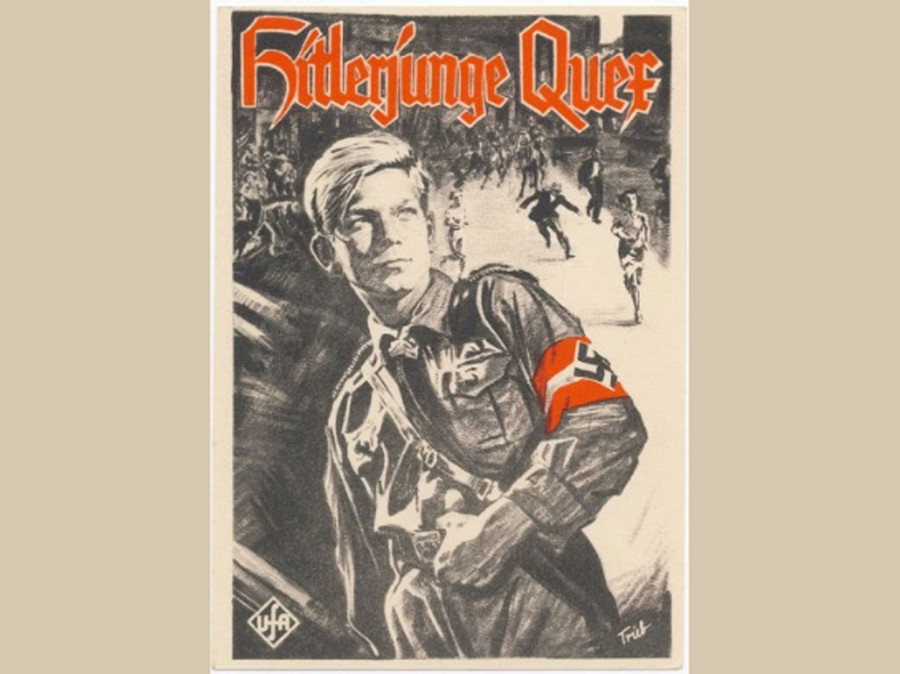
Promotional poster for Hitlerjunge Quex (1933). From IMDB.
Even a cursory glance at the available imagery of actor Jürgen Ohlsen, who played the titular protagonist of Hans Steinhoff’s Hitlerjunge Quex (1933), is striking for how often the young man is depicted leaning. Placards, magazine covers, postcards, print advertisements, radio handbills and theatrical spectacle come together to constitute a collage of reclining Quexes, whose dynamic stance is often emphasized by a dizzying kaleidoscope of urban background imagery and attention-grabbing, tilted text. Attending to such montage, in the sense of an assembly of images, this talk will offer a contextualized close reading of the markedly contrapposto pose Ohlsen strikes in the promotional film poster for the original release of Quex—the first feature officially produced by the Nazi party after they came to power and brought the Weimar film studio Ufa under state control. Situating the figure within a long tradition, historically coded homosexual, of attractive ephebes at an incline, the lecture will probe the uncomfortable imbrications of queer, homosocial and fascist iconographies.
Ian Fleishman is Chair of the Department of Cinema & Media Studies and Associate Professor of Francophone, Italian & Germanic Studies at the University of Pennsylvania. He has published widely on subjects ranging from the Baroque to video pornography. He is the author two monographs—An Aesthetics of Injury: The Narrative Wound from Baudelaire to Tarantino (Northwestern, 2018) and Flamboyant Fictions: The Failed Art of Passing (Northwestern, 2025)—and coeditor, alongside Iggy Cortez, of a volume on Performative Opacity in the Work of Isabelle Huppert (Edinburgh, 2023).